

A Hong Kong man has been handed an 18-month probation order for writing “seditious words” in a Tsim Sha Tsui bathroom, marking a rare instance of a non-custodial sentence being handed down for a national security offence.
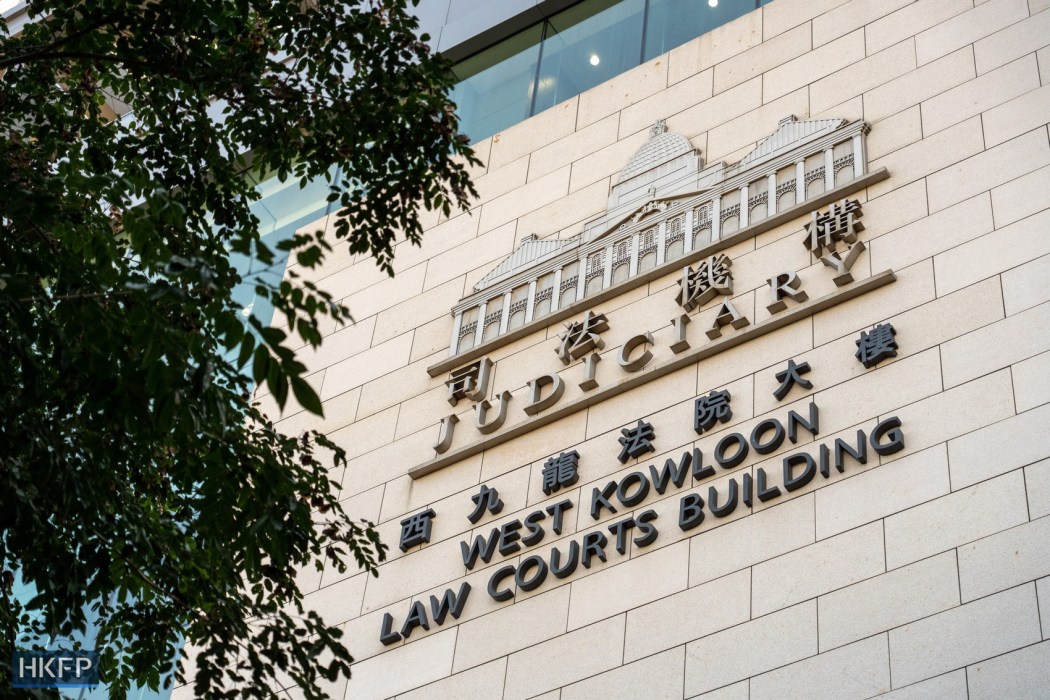 West Kowloon Law Courts Building. File photo: Candice Chau/HKFP.
 Leung Kai-lok – who the defence said has autism – received the sentence at West Kowloon Magistrates’ Courts on Wednesday morning after being convicted last month.
According to the prosecution, the 19-year-old scrawled “seditious words” on the cubicle wall of a male bathroom in China Hong Kong City, a commercial building in Tsim Sha Tsui, on three occasions between July 17 and 21 last year.
He was charged with one count of sedition and three counts of criminal damage, the latter of which he pleaded guilty to.
The seditious messages included “Bomb Lee Ka-chiu to death” in Chinese, an apparent reference to the city’s leader John Lee. He also scrawled the Chinese characters for an abbreviated version of the 2019 protest slogan “Liberate Hong Kong, the Revolution of Our Times.” Courts have ruled the phrase carries seditious intent.
Handing down the sentence on Wednesday, Magistrate Victor So said the influence of Leung’s behaviour was limited as he had written the messages in a bathroom, compared to if they had been posted online or in another public place.
There is no evidence that Leung had any “deep-rooted anti-social traits,” and the four weeks he spent in remand was enough for him to understand the consequences of breaking the law, So added.
In addition to the probation order, Leung was also ordered to pay HK$1,500 in damages to China Hong Kong City.
 China Hong Kong City in Tsim Sha Tsui. Photo: Tourism Board.
Sedition is an offence under the Safeguarding National Security Ordinance, also known as Article 23.
The maximum penalty is seven years, or 10 years if the offender is found to have colluded with an “external force.”
Jail time for defendants convicted of national security-related offences is the default, and non-custodial sentences are almost unheard of.
According to Ming Pao, this is the first time a non-custodial sentence has been delivered under Article 23.
April trial
During the trial in April, a police officer testified that he entered the bathroom on the 11th floor of China Hong Kong City – where Leung worked – at 9.36am on July 21 last year.
 File photo: Kyle Lam/HKFP.
Around an hour later, the defendant walked in and entered the first cubicle, The Witness reported. The officer said he heard a noise that sounded like a whiteboard marker being used.
After that, the officer went to the first cubicle and saw the words written on the walls.
His colleague arrested Leung and brought him to the police station in Tsim Sha Tsui, according to the officer.
Leung’s lawyers argued that their client had autism and dissociative disorder.
Wong Chung-kwong, a psychiatrist who testified for the defence, noted he had four meetings with the defendant, and said his autism symptoms were extremely clear.
 The Hong Kong Police Force emblem. Photo: Candice Chau/HKFP.
Wong said that Leung experienced “obsessive ruminations,” and that he was haunted by scenes such as being pushed into a toilet by his classmates, the events of the 2019 protests and unrest, and a situation whereby a mentally disturbed person uttered profanities near his residence.
He also said that Leung was under pressure at the time of the offence because he had done poorly in his examinations.
That Leung had written “Carrie Lam, step down” – a reference to the ex-chief executive – was evidence that he was experiencing a dissociative episode because Lam is no longer the city’s leader.
The prosecution, however, argued that Leung had written about Lam perhaps because he did not know who the chief executive was. Wong said the possibility of that was very low.
During the trial, a psychiatric expert who testified for the prosecution said he did not think the defendant had autism or any dissociative disorder.
Separate from the 2020 Beijing-enacted security law, the homegrown Safeguarding National Security Ordinance targets treason, insurrection, sabotage, external interference, sedition, theft of state secrets and espionage. It allows for pre-charge detention of up to 16 days, and suspects’ access to lawyers may be restricted, with penalties involving up to life in prison. Article 23 was shelved in 2003 amid mass protests, remaining taboo for years. But, on March 23, 2024, it was enacted having been fast-tracked and unanimously approved at the city’s opposition-free legislature.
The law has been criticised by rights NGOs, Western states and the UN as vague, broad and “regressive.” Authorities, however, cited perceived foreign interference and a constitutional duty to “close loopholes” after the 2019 protests and unrest.
 English (US) ·