

Hong Kong Tiananmen vigil activists Chow Hang-tung and Lee Cheuk-yan have been convicted of incitement to subversion under a Beijing-imposed national security law.
 Hong Kong police set up a cordon outside the West Kowloon Law Courts Building on August 21, 2026, ahead of the verdict hearing of the trial of two Tiananmen vigil activists Chow Hang-tung and Lee Cheuk-yan on national security charges. Photo: Kyle Lam/HKFP.
At the West Kowloon Law Courts Building, three national security judges on Friday handed down the guilty verdict in the trial of Chow and Lee Cheuk-yan, both former leaders of the now-defunct Hong Kong Alliance in Support of Patriotic Democratic Movements of China.
For decades, it organised vigils in Causeway Bay’s Victoria Park to commemorate the 1989 Tiananmen crackdown in Beijing when hundreds, perhaps thousands, were killed as troops dispersed demonstrators around Tiananmen Square.
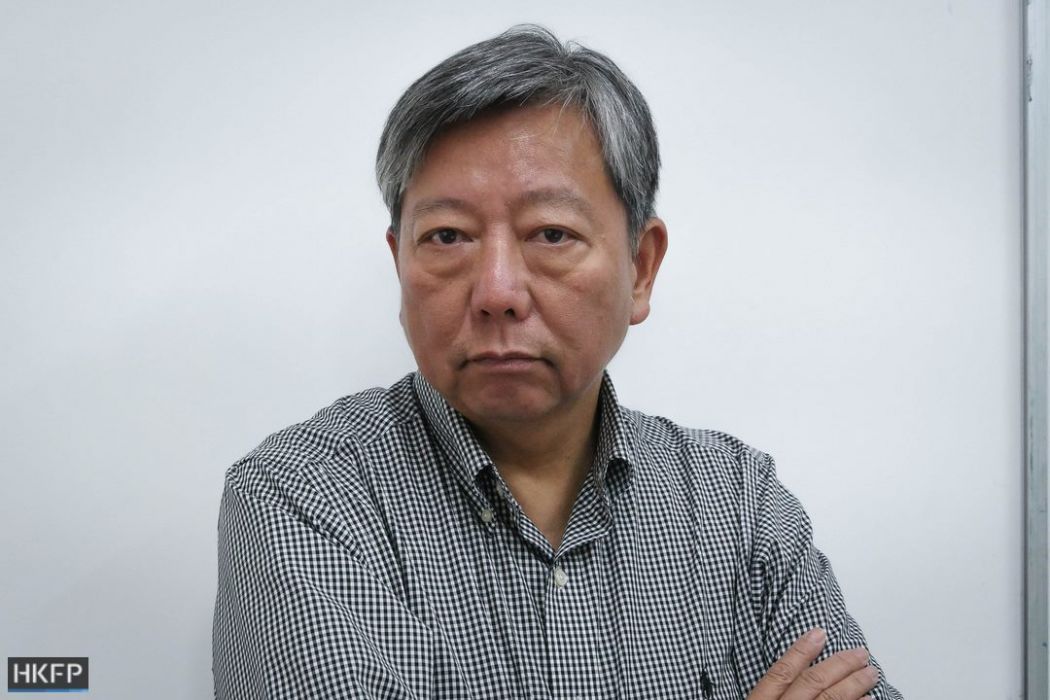 Lee Cheuk-yan. File Photo: Jennifer Creery/HKFP.
 Chow Hang-tung. Photo: Peter Parks/AFP.
The pair, who have been behind bars since September 2021, now face up to a decade in prison.
During the trial, prosecutors accused the Alliance of inciting others to topple the ruling Chinese Communist Party (CCP) through its calls to “end one-party rule” in China, a key tenet of the group since its founding in 1989.
A third defendant, former lawmaker Albert Ho, pleaded guilty when the trial opened in January.
 A Correctional Services Department vehicle is seen entering the West Kowloon Law Courts Building on August 21, 2026, ahead of the verdict in the trial of two Tiananmen vigil activists Chow Hang-tung and Lee Cheuk-yan. Photo: Kyle Lam/HKFP.
In a summary of the verdict reasoning, the judges said Lee, Ho and Chow had “all along been hostile towards the CCP and the Central Government under its leadership… They adhered to the course of resisting the Central Government and refusing to make any compromise.”
After the national security law was implemented, the trio “refused to pull back from the brink and were bent on embracing the resistance line of the Alliance to the very end,” the judges said.
 Hong Kong police set up a cordon outside the West Kowloon Law Courts Building on August 21, 2026, ahead of the verdict in the trial of two Tiananmen vigil activists Chow Hang-tung and Lee Cheuk-yan. Photo: Kyle Lam/HKFP.
The hand-picked judges acknowledged that the activists did not suggest “any specific method or timetable on carrying out the goal of ‘end one party dictatorship,'” and that the Alliance never used or advocated violence.
But they said the defendants still spread the goal of “end one-party dictatorship” after the security law was passed, and compared the anti-extradition protests and unrest in 2019 to the “June 4th Incident” – the Tiananmen crackdown.
 Hong Kong police set up a cordon outside the West Kowloon Law Courts Building on August 21, 2026, ahead of the verdict in the trial of two Tiananmen vigil activists Chow Hang-tung and Lee Cheuk-yan. Photo: Kyle Lam/HKFP.
“[This stirred] up the hostility of [Hongkongers] towards the CCP, eroding and undermining the public’s confidence in its leadership,” they said.
Earlier, prosecutors argued that the Alliance’s calls breached China’s constitution, after a 2018 amendment stipulated that the CCP’s leadership is the “defining feature” of the country’s “fundamental” socialist system.
Tiananmen trio trial verdict summary by HKFP
Chow, a barrister-turned-activist who represented herself throughout the trial, mounted a defiant defence during her closing submission in May.
 Hong Kong’s annual Tiananmen vigil, 2019. File photo: Todd R. Darling/HKFP.
“What the court has been asked to ban, to punish in this case are, in fact, what society and the law should encourage… They are the core values of Hong Kong, the norms and ideals accumulated through generations,” she told the court in Cantonese.
Lawyer Erik Shum, who represented Lee, urged the court that it “must not pay lip service” to human rights protections, as he argued that freedom of expression was at stake.
Mitigation next Friday
As Friday’s verdict was handed down, some family members and friends in the public gallery raised their fists and made heart signals at the defendants.
The proceedings were adjourned to next Friday morning for mitigation ahead of sentencing, whereby the trio face up to 10 years’ imprisonment.
 Representatives of foreign consulates in Hong Kong arrive at the West Kowloon Law Courts Building on August 21, 2026, ahead of the verdict in the trial of Tiananmen vigil activists Chow Hang-tung and Lee Cheuk-yan. Photo: Kyle Lam/HKFP.
Judge Alex Lee cited Article 23 of the national security law, which outlines the sentencing principles for subversion offences.
The article states that, if the circumstances of the offence are of a “serious nature,” the defendant should be jailed for between five and 10 years. If the case is deemed of a “minor nature,” the defendant faces up to five years’ jail.
 Elizabeth Tang (centre), a veteran pro-democracy activist and the wife of Tiananmen vigil activist Lee Cheuk-yan, arrives at the West Kowloon Law Courts Building on August 21, 2026, ahead of the verdict in the trial of her husband and fellow Tiananmen vigil activist Chow Hang-tung. Photo: Kyle Lam/HKFP.
Lee said he hoped prosecutors would give guidance on the categorisation.
 Chow Hang-tung’s mother outside the West Kowloon Law Courts Building on August 21, 2026, after the verdict in the trial of her daughter and fellow Tiananmen vigil activist Lee Cheuk-yan. Photo: Kyle Lam/HKFP.
Chow Hang-tung’s mother told reporters after the verdict that she hoped “the environment will become healthy and flowers of different colours will blossom.” She was accompanied by former Alliance member Lau Ka-yee, whose t-shirt bore the slogan “People will not forget.”
Heavy police presence
Amid a heavy police presence outside the courtroom on Friday morning, supporters of the activists hugged each other and chatted with their friends and family members, including Lee’s wife, Elizabeth Tang.
As with other major national security cases, the Judiciary opened up an extension courtroom where the proceedings were broadcast to cater to the large number of journalists and members of the public.
 Activist Lui Yuk-lin outside the West Kowloon Law Courts Building on August 21, 2026, ahead of the verdict in the trial of two Tiananmen vigil activists Chow Hang-tang and Lee Cheuk-yan. Photo: Kyle Lam/HKFP.
People started lining up for public gallery tickets as early as Tuesday – local media have previously suggested that some may be members of “queuing gangs.” They are not pro-democracy supporters, but believed to be paid by unknown groups to grab tickets to reduce the chances of others being able to get a seat in the main courtroom.
 Elizabeth Tang, a veteran pro-democracy activist and the wife of Tiananmen vigil activist Lee Cheuk-yan, at the West Kowloon Law Courts Building on August 21, 2026, after the verdict in the trial of her husband and fellow Tiananmen vigil activist Chow Hang-tung. Photo: Kyle Lam/HKFP.
Several former members of the Alliance, including Tang Ngok-kwan and Lau Ka-yee, were present at the proceedings. Other activists, including dentist Lee Ying-chi and “female Long Hair” Lui Yuk-lin, also attended the verdict.
 Hong Kong police set up a cordon outside the West Kowloon Law Courts Building on August 21, 2026, ahead of the verdict hearing of the trial of two Tiananmen vigil activists Chow Hang-tang and Lee Cheuk-yan on national security charges. Photo: Kyle Lam/HKFP.
Both Tang Ngok-kwan and Lee Ying-chi told local media they were searched by police and asked not to bring certain items into the court building. Materials that Tang had brought along included old newspaper clippings relating to the Alliance – they were confiscated by police.
Lee said a keychain from the Hong Kong Journalists Association was also taken by police, according to The Witness.
 Outside the West Kowloon Law Courts Building on August 21, 2026, after the verdict in the Tiananmen vigil trio trial. Photo: Kyle Lam/HKFP.
They were told they could pick them up at the police station later, local media reported.
The Alliance disbanded in 2021 after authorities banned the vigil for two years, citing Covid-19 restrictions, and arrested its leadership on national security allegations.
 English (US) ·