

On a sprawling promenade in West Kowloon, a gay choir lit up the stage with a chorus of harmonies. Children listened attentively at a storytelling session led by a drag queen dressed in pink from top to bottom.
 Pink Dot at the West Kowloon Cultural District on December 10, 2023. Photo: Pink Dot HK, via Facebook.
Around them, dozens of tents representing LGBTQ-friendly NGOs promoted their services and ran mini games.
These were scenes from Hong Kong’s largest LGBTQ event, Pink Dot, when it was last held in September 2024. The event attracted thousands of people, including families with young kids.
Since then, the annual outdoor carnival, which aims to celebrate diversity, has been axed for two consecutive years, including the one scheduled for this month.
The organisers announced the cancellation on May 18, around five weeks after they said Pink Dot would take place at Stanley Plaza and Murray House in mid-June, coinciding with Pride Month.
The event was also cancelled last year after the West Kowloon Cultural District Authority (WKCDA) declined to rent its Art Park venue to the organisers, although it had done so for five years.
Pink Dot started in Singapore in 2009, and five years later, Hong Kong held its inaugural event. For the first two years – in 2014 and 2015 – the carnival was held at Tamar Park in Admiralty.
In later years, Pink Dot took place at Art Park – except during the 2019 protests and the pandemic restrictions between 2020 and 2022, when the organisers cancelled or moved the event indoors.
 Pink Dot Hong Kong co-director Brian Leung at Art Park, in West Kowloon Cultural District, on May 22, 2026. Photo: Kyle Lam/HKFP.
To hold a public event like Pink Dot, organisers must apply for a Temporary Places of Public Entertainment Licence from the Food and Environmental Hygiene Department (FEHD).
Brian Leung, co-director of Hong Kong’s Pink Dot, told HKFP in late May that Link REIT, the venue operator, had informed the organisers that it could not rent the site in June because it had heard of “problems” with the event’s licence application to the FEHD.
Leung said it was unclear how Link REIT heard there were “problems” with the event’s licence application. He was never aware that there was ever any problem.
“So far I have not gotten any official explanations,” Leung said in Cantonese. “As an organiser, I cannot guess [what happened].”
 Pink Dot at the West Kowloon Cultural District on December 10, 2023. Photo: Kyle Lam/HKFP.
In response to HKFP’s enquiry, the FEHD said on May 21 that it received Pink Dot’s application in late April, but the event organisers told the department on May 18 that they had cancelled the event.
The applicant “said it would formally withdraw the application later, so the department does not have any follow-up,” the FEHD wrote in an email.
‘No political aims’
Pink Dot is not the only LGBTQ event that has encountered problems over the past year. The WKCDA axed a queer-themed play, We Are Gay, in October, nearly six weeks before it was set to open at the Xiqu Centre in the cultural district.
The following month, the Hong Kong Pride Committee – which used to hold the city’s Pride marches – called off an outdoor festival at Kwun Tong Promenade after the venue operator said the site was unavailable due to construction work. The last Pride march was held in 2018.
The cancellations have raised questions among LGBTQ activists about the future of holding events in Hong Kong.
“We do have concerns,” Leung said. “Does it mean that going forward, it will be very hard or impossible to find venues for events that are LGBTQ-related?”
In late July last year, Pink Dot’s organisers were forced to cancel – four weeks after the government released its proposed framework for a bill allowing same-sex partners to register their relationships. The bill was to comply with a Court of Final Appeal ruling in a lawsuit filed by LGBTQ activist Jimmy Sham.
 LGBTQ activist Jimmy Sham outside the Legislative Council on Sept. 10, 2025. Photo: Kyle Lam/HKFP.
Sham, a former district councillor, told HKFP that when Pink Dot was cancelled last year, he thought it might be because the timing was sensitive, citing the government’s attempt to pass the framework.
The bill was eventually voted down in the “patriots only” Legislative Council in September, with many lawmakers citing a need to “uphold” traditional Chinese family values.
“But now that it’s been cancelled for a second year, people don’t have any idea why,” Sham said in Cantonese.
Leung said he brought Pink Dot from Singapore – where the event is still held every year – to Hong Kong in 2014, seeing it as a family-friendly celebration of diversity.
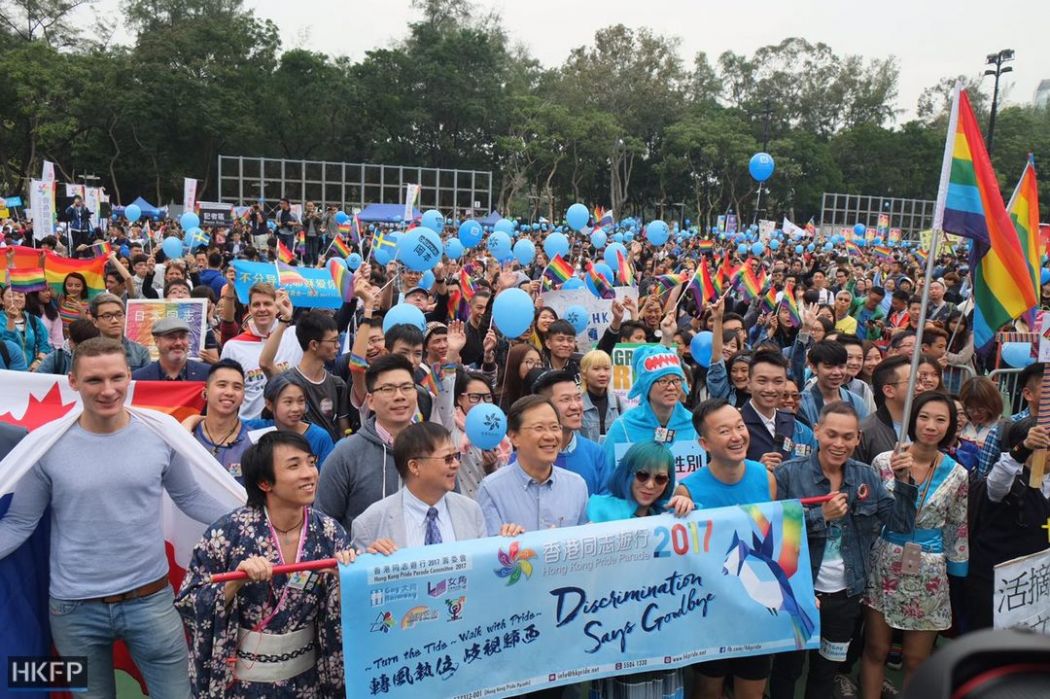 Pro-democracy lawmakers Raymond Chan and Kwok Ka-ki take part in Hong Kong’s Pride Parade in 2017. Photo: Kris Cheng/HKFP.
At the time, Hong Kong had annual Pride parades, with different themes each year, such as “Call for the law, equality for all” and “Stand up for diversity.” It was an opportunity for LGBT groups and their allies, including pro-democracy lawmakers, to rally on the city’s streets, waving rainbow flags and chanting slogans.
Since the Covid-19 pandemic, the organisers of the Pride march have only held indoor events.
“I thought it would be good to have an event like Pink Dot, which is different in nature. The Pride marches had clear political aims, while Pink Dot is softer, with no political aims,” Leung said.
Shrinking LGBTQ space in mainland China
Restrictions on the LGBTQ community in mainland China, where advocacy groups have been forced to disband and queer content has been censored, are not lost on Hong Kong activists and academics.
Jamie Zhao, an assistant professor and scholar on queer media at the City University of Hong Kong, said the shrinking space for LGBT activism could not be separated from mainland authorities’ lack of tolerance for publicly disruptive and “rights-demanding” activities.
The official attitude towards the LGBTQ community is closely aligned with the country’s renewed emphasis on family values, marriage and fertility, Zhao told HKFP. Amid an ageing population and low birth rates, the Chinese government has been encouraging citizens to marry and have children.
See also: ‘Boys’ Love’ dramas dance around China’s LGBTQ censors
“Queer life can be framed as non-reproductive, individualistic, foreign-influenced, or insufficiently aligned with the future of the nation,” Zhao said.
However, Zhao said mainland authorities’ approach to the LGBT community could not be described as a total crackdown. The growth in gay and lesbian bars, “boys’ love” and “girls’ love” drama series, LGBTQ reality dating shows and other elements that make up the “pink economy,” the academic said, shows that “commercially useful queer-coded culture” is still allowed to exist.
 Posters featuring boys’ love at a merchandise shop in Beijing on July 9, 2025. Photo: Adek Berry/AFP.
John Burns, an honorary professor at the University of Hong Kong’s Department of Politics and Public Administration, also said the official stance on LGBT matters in mainland China was a mixed picture.
Despite restrictions, Chinese production companies are still making new “boys’ love” dramas to meet popular demand, and they have not been shut down by authorities, Burns said.
In any case, the scholar said he did not believe the Hong Kong government was attempting to ban LGBTQ communities from gathering, or that there had been any related directive from the central government.
“I don’t think the central government is micromanaging Hong Kong on [LGBTQ] issues. I think they’re more likely to be micromanaging Hong Kong on national security issues,” Burns told HKFP.
‘Greater risk of disorder’ outdoors
Since the Beijing-imposed national security law was passed in 2020, large-scale outdoor events like marches and rallies have all but dried up. Besides political protests, the city no longer sees marches on topics like labour issues and women’s rights as it used to be.
“If the real issue is that the police are worried about national security, and people exploiting the outdoor event for something that it wasn’t designed for, then [the Hong Kong government] should say so,” Burns said.
Former lawmaker Regina Ip, who leads the government’s advisory body, the Executive Council, told HKFP that police tend to think outdoor events carry a “greater risk of disorder.”
She pointed to the Gay Games opening ceremony in 2023, which “was held at the Queen Elizabeth Stadium and went very well.”
 Top government adviser Regina Ip delivers a speech at the opening ceremony of Gay Games 2023 on November 4, 2023. Photo: Graham Uden/Gay Games Hong Kong.
 Hong Kong co-hosted the international sporting event with Mexico in 2023, welcoming participants from around the world. However, the Gay Games in the city, which did not receive government sponsorship, saw far less participation than originally expected.
Like last year, Pink Dot organisers are looking into holding a private indoor event that will be livestreamed to the public, Leung said.
Asked whether Pink Dot would consider moving its event indoors in the future, Leung expressed concerns that they would still face problems getting an entertainment licence.
To Zhao, the visibility of the LGBT community has become “politically more vulnerable” in recent years because of its association with the non-establishment camp.
“Many openly queer or queer-associated public figures were connected directly or indirectly to pro-democracy politics, civil society, activism or critical public discourse,” she said.
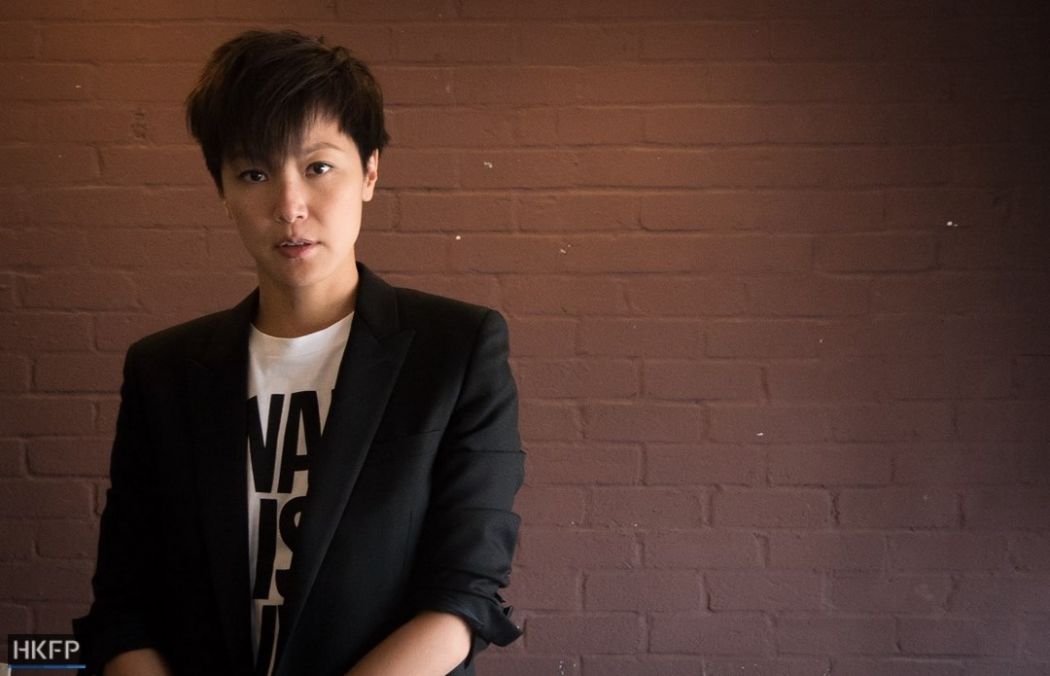 Cantopop singer Denise Ho. File photo: Jennifer Creery/HKFP.
Zhao referred to singer Denise Ho, who came out publicly during the Pride parade in 2012 and has spoken out about her pro-democracy stance.
Many politicians who took part in Pride parades belong to the pro-democracy camp, such as Leung Kwok-hung, also known as “Long Hair”; Raymond Chan, the first openly gay lawmaker; and Sham, one of the openly LGBTQ district councillors elected in 2019.
Leung, Kwok, Chan, and Sham were among the 47 democrats charged in a landmark national security case involving a primary election in 2020, and among the 45 who were jailed.
Zhao said: “This close association between queer culture and civil society has made queer visibility in Hong Kong more politically charged than in many mainland commercial contexts.”
‘Big loss’
Despite Pink Dot’s cancellation, some local activists are still hopeful that an LGBTQ space exists for the community to gather and celebrate diversity.
 Jerome Yau on January 8, 2026. Photo: Kyle Lam/HKFP.
Jerome Yau, co-founder of Hong Kong Marriage Equality and chief executive of AIDS Concern, pointed to the fact that an outdoor event marking International Day Against Homophobia, Biphobia, and Transphobia (IDAHOBIT) went ahead over a weekend in mid-May.
On May 16 and 17, various organisations – from NGOs to an LGBTQ-friendly church and a queer advocacy media outlet – set up street booths in the heart of the Causeway Bay shopping district. The same event was held last year.
Yau acknowledged that organisers of large-scale events in Hong Kong faced “growing challenges” nowadays, but said he saw “no evidence” that Link REIT was under pressure.
 LGBTQ groups mark International Day Against Homophobia, Biphobia and Transphobia (IDAHOBIT) on May 17, 2025. Photo: Kyle Lam/HKFP.
“Whatever those licensing issues may be, I hope there is more clarification,” he said.
Nick Lee, a lecturer at the Chinese University of Hong Kong’s Gender Studies Programme, however, said he felt it was possible that the venue operator did not experience direct pressure to refuse rental to Pink Dot organisers, but withdrew on its own accord out of an abundance of caution.
Still, Yau found it disappointing that Pink Dot could not be held for a second year in a row.
The event “had a good track record. It was a good sign that Hong Kong at the very least embraces diversity and inclusion,” he said.
“It’s obviously a big loss not just to the LGBTQ community, but to the whole of society.”
 English (US) ·