

Hong Kong introduced new national security rules in March that empower police to demand that national security suspects surrender passwords to their devices. Meanwhile, an independent bookshop owner and his employees were arrested for allegedly selling seditious books.
 A sign reads “Closed for one day due to an unexpected incident. Apologies for the inconvenience,” at Book Punch in Sham Shui Po on Tuesday, March 24, 2026. Photo: Kyle Lam/HKFP.
The national security trial of two Tiananmen vigil activists continued, and the city’s largest teachers’ union officially dissolved.
New national security amendments
The government introduced amendments to the “implementation rules” of the national security law that Beijing imposed in 2020.
Under the new rules, gazetted on March 23, police can require people under national security investigation to provide passwords or help decrypt their electronic devices.
Failure to do so can be punished by up to one year behind bars and a HK$100,000 fine. Providing a false or misleading statement is punishable by up to three years’ imprisonment and a fine of HK$500,000.
 Social media apps on a smartphone. Photo: dole777/Unsplash.
The new rules also empowered customs officers to freeze or confiscate assets relating to national security crimes or to forfeit “articles that have seditious intention.”
Such powers were previously restricted to the secretary for justice, the secretary for security, and the police force.
In an attempt to quell public concerns, security chief Chris Tang described claims that police could stop people on the street and demand their phone passwords as “false and misleading.”
Tang said in the Legislative Council (LegCo) on March 26 that with the new requirements in place, there was public concern that police would randomly demand that citizens on the street hand over mobile phone passwords.
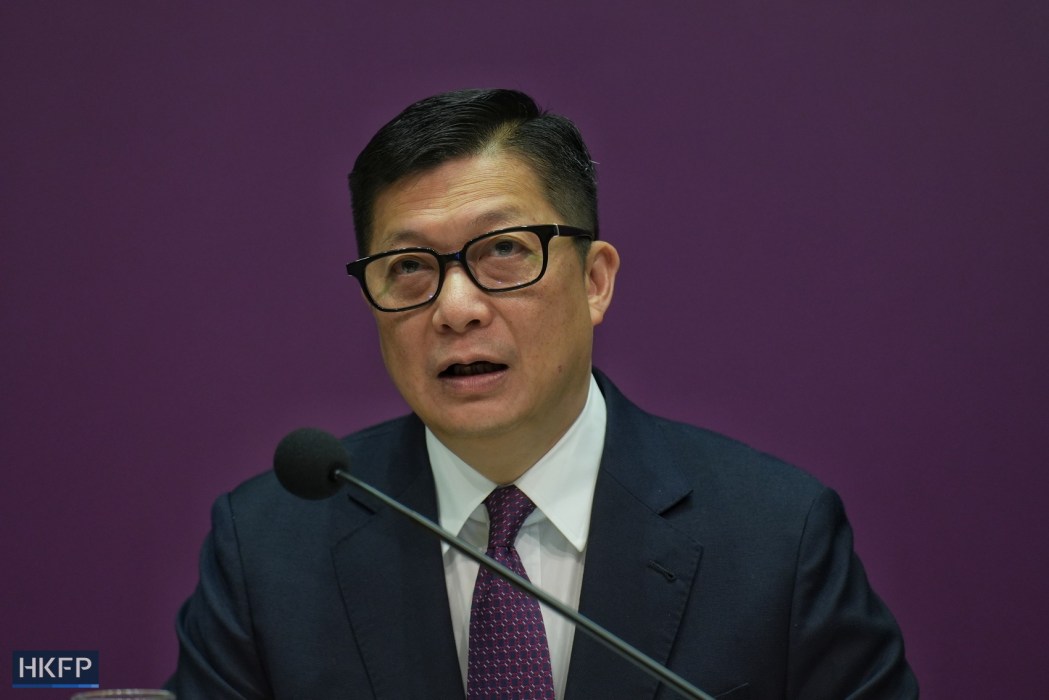 Secretary for Security Chris Tang. File photo: Kyle Lam/HKFP.
 The minister said that police must apply for a court warrant providing “national security reasons” before requesting people suspected of endangering national security to hand over mobile phone passwords.
China summons top US diplomat
Beijing summoned the top US diplomat in Hong Kong after the US Consulate General issued an alert over a new rule in the financial hub empowering police to demand that national security suspects surrender their passwords.
 US Consul General Julie Eadeh (centre) at her welcoming reception. Photo: US Consulate General in Hong Kong and Macau, via Facebook.
In a statement on February 28, Beijing’s foreign ministry office in Hong Kong said it had summoned Julie Eadeh, the US consul general in Hong Kong, for “solemn representations.”
The statement said the move was in response to the “so-called ‘security alert’” issued by the US Consulate General on February 26, days after the Hong Kong government introduced the new national security rule.
Bookshop owner, staff arrested
In late March, Hong Kong independent bookseller Pong Yat-ming and three of his staff members were reportedly arrested on suspicion of selling seditious titles, including a biography of jailed media tycoon Jimmy Lai.
Local media reported on March 24 that national security police arrested one man and three women for allegedly “knowingly selling a publication that has a seditious intention,” an offence under Hong Kong’s homegrown security law, the Safeguarding National Security Ordinance, known locally as Article 23.
 A seven-seater vehicle in Sham Shui Po, outside a building where independent bookstore Book Punch is located, on March 24, 2026. Moments before the photo was taken, a woman was seen being escorted from the bookstore by people who appear to be wearing police lanyards into the vehicle. Photo: Kyle Lam/HKFP.
Citing anonymous sources, the reports said police also raided Book Punch – Pong’s Sham Shui Po bookstore – and seized allegedly seditious publications, including Lai’s 2024 biography – The Troublemaker: How Jimmy Lai Became a Billionaire, Hong Kong’s Greatest Dissident, and China’s Most Feared Critic.
The bookstore owner and the employees were released on bail on March 25, Book Punch said on Facebook. Pong confirmed with HKFP that he and his staff had been released on bail, but he could not say anything about the case.
Trial of Tiananmen vigil activists
The high-profile national security trial of Tiananmen vigil activists – barrister Chow Hang-tung and unionist Lee Cheuk-yan – continued in March.
The former leaders of the now-disbanded Hong Kong Alliance in Support of Patriotic Democratic Movements of China are standing trial for “inciting subversion,” which carries a maximum penalty of 10 years in jail. The third defendant, solicitor Albert Ho, pleaded guilty when the trial opened in January.
The case revolves around the Alliance’s key slogan calling for “an end to one-party rule” in China, which prosecutors allege amounts to a breach of China’s constitution and incitement to subversion.
On March 5, a panel of three national security judges ruled to bar a Taiwanese academic from testifying as the evidence he planned to give was deemed “irrelevant” to the case. Chow had initially applied to have Ho Ming-sho, a sociology professor at National Taiwan University, testify in the trial.
 The Tiananmen vigil in Victoria Park on June 4, 2018. Albert Ho (second from left), Chow Hang-tung (third from left), and Lee Cheuk-yan (third from right) are photographed on stage. File photo: Kris Cheng/HKFP.
Both defendants had sought early acquittals from their charges, arguing that the prosecution failed to present sufficient evidence.
Lee’s barrister, Erik Shum, argued that prosecutors had misinterpreted the Chinese constitution and erred in saying that there are no “lawful means” to call for an end to the Chinese Communist Party’s (CCP) rule. The lawyer also told the court that calling for an end to the CCP’s rule does not mean “overthrowing” its government and state organs.
Chow, who represents herself, said the prosecution had adopted a broad reading of the Chinese constitution and had erred in alleging that she had directly breached it. The Alliance’s slogans fell within a Chinese citizen’s legitimate demand for choosing the country’s leadership, she also told the court.
However, the court ruled on March 13 that the prosecution established a prima facie case against Chow, Lee, and the Alliance, and the trial would go on.
Taking the stand on March 17, Lee denied that his demand for an end to one-party rule in China amounted to a call to overthrow the CCP. “I have no enmity in my heart, only love. Based on my love for the people, I hoped the Communist Party would reform, to let people have the rights and happiness they deserve,” he said the following day.
 Activists Lee Cheuk-yan (sixth from right), Chow Hang-tung (fifth from right) and Albert Ho (fourth from right) at the Tiananmen vigil in Victoria Park on June 4, 2018. Photo: Catherine Lai/HKFP.
Later, on March 20, Chow told the court that the Tiananmen vigils had “always promoted love and responsibility” rather than “hatred and despair.”
She also said writings published by the Alliance were not meant to be subversive, but to expose Hongkongers to democratic movements in mainland China. Her articles were intended to “tell stories” about Chinese activists facing oppression, including the late dissident Liu Xiaobo and his widow Liu Xia, she added.
On March 25, she played a video of the 2018 vigil in the courtroom, as well as a clip of Di Mengqi, a member of the Tiananmen Mothers, recounting the death of her son during the 1989 crackdown. “The most important session of the vigils was the speeches by the Tiananmen Mothers. They are the most directly affected parties and victims of the crackdown,” she said.
The following day, Chow told the court that the Alliance held internal discussions to address “concerns that the national security law would be used as a tool for political suppression,” weeks before its implementation in late June 2020.
Chow called three defence witnesses to testify in court. Former Alliance volunteer Choi Shuk-fong, 66, said she witnessed the Tiananmen crackdown when she was working as a journalist for Sing Tao Daily.
 Former journalist and Tiananmen Square crackdown eyewitness Choi Suk-fong (right) exits the West Kowloon Law Courts on March 30, 2026. Photo: James Lee/HKFP.
However, the judges barred a photo of injured, bloodied protesters at Tiananmen Square, which was taken by Choi, from being shown in court. “At the moment, I don’t see how this can help the court,” Judge Alex Lee said. Instead, Judge Johnny Chan verbally described the image.
A second defence witness, former vigil attendee Shum Lai-fong, 69, told the court she believed the Alliance’s call for an end to one-party rule was not directed at any specific party.
Kwan Chun-pong, 54, a former standing committee member and volunteer of the Alliance, also testified as a defence witness for Chow. Judge Lee instructed Chow to ask Kwan only questions about matters from 2018 onwards.
 Activist Kwan Chun-pong leaves the West Kowloon Law Courts Building on March 31, 2026. Photo: Hillary Leung/HKFP.
At one point, the judge reprimanded Chow when she referred to the crackdown as the “June 4 massacre.” “If you use phrases like this, I will need to consider whether to allow you to continue asking questions,” he said, correcting the term to “June 4 incident.”
Judge Lee adjourned the case to May 18 for the prosecution and the defence to present their closing submissions.
Appeals in Apple Daily case
Pro-democracy media tycoon Jimmy Lai decided not to appeal against his national security conviction and jail term, his lawyer said on March 6, nearly one month after the sentencing of the Apple Daily founder. The lawyer did not elaborate on the reason for not appealing.
Lai, 78, was sentenced to 20 years behind bars on February 9 – the longest jail term handed down so far under the Beijing-imposed national security law.
Two of his eight co-defendants filed an appeal against their 10-year sentences.
Fung Wai-kong, former editorial writer and editor-in-chief of Apple Daily’s English news section, and Lam Man-chung, former executive editor-in-chief at the tabloid, filed their appeals on March 2 and March 10, respectively, according to local media and High Court documents.
 Fung Wai-kong. Photo: Internet.
 Eight co-defendants – including Fung, Lam and four other former Apple Daily executives – pleaded guilty and were sentenced to up to 10 years in prison alongside Lai.
Dissolution of the city’s largest teachers’ union
The pro-democracy Hong Kong Professional Teachers’ Union (HKPTU) officially dissolved last month – nearly five years after it announced steps to disband.
The Registry of Trade Unions gazetted on March 27 that the HKPTU – the city’s largest teachers’ union – was dissolved, marking the end of the group’s half-century of history.
 Hong Kong Professional Teachers’ Union. File photo: Candice Chau/HKFP.
Once a prominent force in Hong Kong’s civil society and democratic movement, the 53-year-old union had over 95,000 members before its dissolution, representing 90 per cent of the profession.
The HKPTU announced it would disband in August 2021, days after attacks by Chinese state media and the Education Bureau’s decision to cut ties with the union.
Film competition with nat. security terms
The Hong Kong Arts Centre (HKAC) revived an Asian film competition in early March after a 17-month hiatus, adding new terms requiring participants to ensure their work complies with the city’s national security legislation.
The HKAC’s Incubator for Film and Visual Media in Asia (ifva) Awards opened for applications on March 1.
According to the awards’ rules and regulations, “entrants must acknowledge and agree [that] the submitted entry… does not violate any provisions of the National Security Law, including these pertaining to secession, subversion, terrorist activities, and collusion with foreign entities.”
Prosecution and arrests figures
As of March 1, a total of 389 people have been arrested for “cases involving suspected acts or activities that endanger national security” since Beijing’s national security law came into effect, according to the Security Bureau. That figure includes those arrested under Article 23.
Of the 208 people and five companies that have so far been charged, 179 people and four companies have been convicted or are awaiting sentencing.
In total, 98 people and four companies have been charged under Beijing’s national security law, with 79 persons and three companies convicted. 13 people have been charged under Article 23, nine of whom have been convicted.
 English (US) ·